Piano Flow Legacy
The Way of Motion and Sound
I don’t promise mastery in two weeks. I teach a method for a lifetime rooted in centuries of sharpened mastery.
Practice at your own rhythm, but never stop learning and improving yourself. No magical quick-fixes, no glowing screens. Just the deep path to join an unbroken lineage and become your own conductor.
“Become your own conductor”
This method is directly addressed to musicians who sit at the keyboard with a technical and theoretical background that makes them feel trapped. The goal is not to accumulate new intellectual concepts, but to clear away everything else to keep only the absolute essentials: the body and total relaxation, an intuitive approach, and each individual’s personal culture. The objective is to overcome obstacles with method and resilience in order to become your own conductor. To achieve this, everything begins and ends with hearing: the physical gesture is nothing more than the direct extension of the ear. Absolutely nothing is built on the piano without attentive, constant, and deep listening.
“The gesture is the extention of the ear”
“only three fundamental structures”
The Physical Footprint and Space
To make the fingers flow, musicians must first reclaim the entire keyboard in a concrete way. A brief clarification of the principles of tonality and modes is enough to set the landmarks. Everything else boils down to a simple geometric reality: all existing chords stem from only three fundamental structures. To simplify visual and tactile integration, all of these principles are explained in C major. Once this initial playground is mastered, musicians can easily adapt and transpose these shapes into all other keys. By exploring how all other combinations develop from these three initial shapes, the hands learn to map out the complete space of the instrument. The playing then comes alive in a natural movement between tension and rest. Rest is never a goal in itself or an obligatory end; it is a state of suspension, a breath that coexists freely with tension at the heart of the musical flow.
“map out the complete space of the instrument”
“precise physical gestures”
Bodily Mechanics and Sound
The flow comes to life through precise physical gestures applied directly to the instrument. Technique is no longer a constraint; it becomes the conducting channel. Movement thus integrates the flexible mastery of the wrist, the physical precision of leaps, and the rigorous control of sound dynamics to sculpt the material of sound. The pedal comes into play here as a major technical tool, essential for binding notes together and giving depth to the resonance. In this comprehensive approach to the keyboard, the left hand steps out of the shadows: a specific focus is dedicated to it so that it expresses itself with the same fullness and freedom as the right hand.
“comprehensive approach to the keyboard”
“Steering your own trajectory”
Time, Independence, and Identity
Steering your own trajectory ultimately requires learning how to divide time and organize movements autonomously. Exercises targeted at rhythm make it possible to tame the pulse and overlay different temporal structures through polyrhythm. This independence opens the doors to polyphony, developing the capacity to make several independent melodic lines coexist and sing at the same time.This method helps to understand the deep connection that unifies all musical genres and all aesthetics. This is precisely where the connection with your personal musical culture is made. It is this unique identity, forged by your own listening and your individual journey, allied with the keys of this method, that fuels the movement and allows you to make your fingers flow while fully mastering your instrument.
“fully mastering your instrument”
A Note on the Philosophy of the Method: The Way of Liberation
This method does not belong to any frozen tradition, aesthetic current, or ideological cage. It rejects the dogmas of academic circles. The title, The Way of Gesture and Sound, states a lived reality: music on the piano comes down to the pure interaction between the living movement of the body and the resonance of the instrument. The method is a tool at the service of the hand, the hand at the service of the piano, the piano at the service of the music, and the music at the service of the human soul.
The technique presented in these pages is not a static heritage to be venerated or blindly reproduced, but a quest for anatomical optimization. Reflex, flexibility, and tension management are not stylistic choices. They are the universal keys to freeing the gesture from physical constraints. Classical music is not a single culture; it is a mosaic of currents that have all shared, for centuries, this exact same quest: perfecting the method to transcend technique and liberate the music.
By focusing the work on the natural functioning of the body, this approach refuses to format you or dictate an aesthetic. Culture is your personal history, the forge of your sensitivity and your unique journey. This method imposes nothing: it is the neutral and caring tool destined to untie your hand, allowing you to fully explore and inhabit your own musical territory.
YOUR PIANIST GUIDE DARIO SCIRE SCAPPUZZO‘S DIRECT MASTERS: LIVING THE LEGACY
Eugène Galand (The Spiritual Father — The Unrecognized Genius)
He was only 18 years old when I walked into his studio as a young kid who knew nothing. Yet, at that age, he had already graduated from the conservatory with the highest possible distinction. He was the definition of an unrecognized genius: possessing the raw energy of a jackhammer combined with the sensitivity of an entire world. He quickly became my spiritual father. Eugène did not just teach me the piano; for ten years, he patiently planted the seeds of philosophy, self-discovery, and the sacred value of music. Every breakthrough that grew into this method stems from the foundation he built.
Evgeny Moguilevsky (The Tectonic Force — 1st Prize Queen Elisabeth Competition 1964)
His strength came from his pure, overwhelming presence. He was the definition of a raw, uncompromising artist—a titan at the piano, yet simultaneously capable of a breathtaking, bird-like softness. When he wanted to convey a message, he did not speak: he sat at the keys, and his playing became a direct bridge to my soul. His words were minimalist, short like a dance track. His obsessive repetitions—”Again… no, again… too loud, no accent…”—were not mere instructions. They were a mantra designed to push me to the very edge of my capabilities, forcing me to find the absolute core of my potential.
Lev Naumov (The Godfather of the Russian Piano School — Neuhaus’s Assistant)
He radiated a unique aura: you could instantly feel that he had rubbed shoulders with the greatest minds and artists of the 20th century. He carried the weight and glory of that history within him, and this immense legacy was palpable in every single moment. He had the unique gift of dropping the exact word at the perfect time—the precise sentence that instantly changed your dimension and shattered your mental blocks. From him, I learned that a great teacher does not overload your brain; he sharpens your inner ear until your hands find the way organically.
André Dumortier (The Architect of the Soul — Eugène Ysaÿe Competition Laureate 1938)
His lessons were long monologues, magnificent stories where every piece, every measure, and every gesture became a book of philosophy in itself. He taught me that music does not comment on thought; it dominates it. For him, Beethoven was not a philosopher trying to put concepts into music; he was the one who would have shown Plato himself that rational thought must bow before the creative power of sound. Dumortier embodied pure poetry, an eternal youth, and an infinite joy. He bequeathed to me the sacred architecture of the gesture.
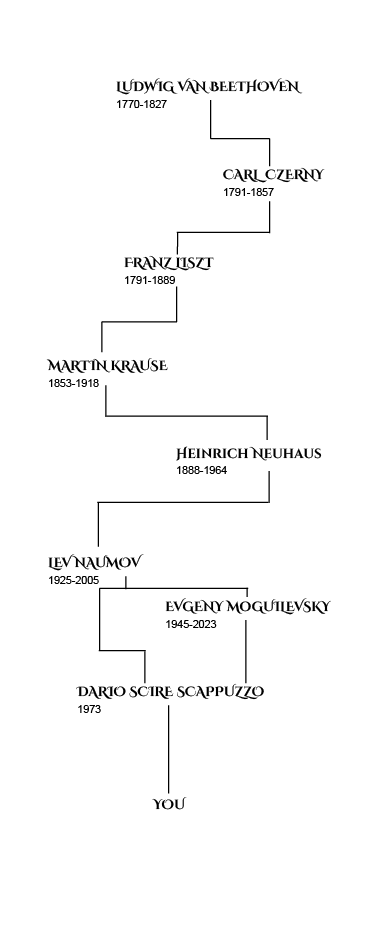
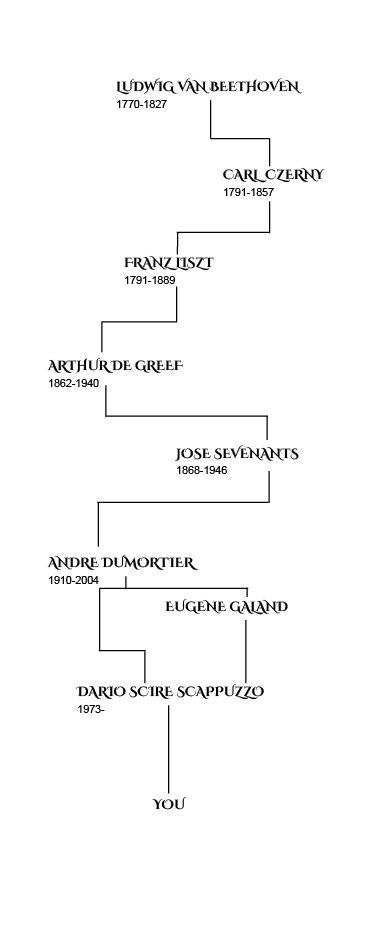
An Unbroken Chain of Mastery
The freedom of movement you are about to discover in Piano Flow Legacy is not a modern reinvention. It is the secret of an unbroken transmission that rolls back in a straight line to the roots of romantic and classical piano mastery. When you join this method, you are not just purchasing a course; you are stepping into a centuries-old lineage. You are quite literally just a few handshakes away from Franz Liszt and Ludwig van Beethoven.
This family tree is a living, breathing memory of the gesture. It began with Beethoven’s dramatic depth of arm mass, traveled through Czerny’s precision, and exploded into Liszt’s orchestral freedom. That very same flame was passed down to Martin Krause, and then to Heinrich Neuhaus, the absolute father of the Great Russian Piano School. From that fountain of wisdom came my own direct mentors, Lev Naumov and Evgeny Moguilevsky.
But the heritage does not stop there. On the other side, that very same genius of Franz Liszt was passed directly to his disciple ArthurDe Greef, then to JoséSévenants, and finally to the immense figure of André Dumortier. Dumortier not only taught me the sacred architecture of the gesture, but he also trained my first teacher, Eugène Galand, when he was a young prodigy.
Every master in this lineage, my own mentors, myself, and now you, we all share the exact same musical DNA. We share the same quest: how to optimize the human body so that technique disappears and only the soul speaks. By connecting yourself to this bloodline, you are no longer just a student sitting at a keyboard. You become the official heir to a multi-century workshop.Welcome to the lineage. Reclaim your inheritance